The Role of AI in Streamlining Content Research for Digital Marketing Success
Content is the backbone of every successful digital marketing strategy. Whether you’re running a startup, managing an eCommerce brand, or growing a personal brand, creating valuable content consistently is one of the biggest challenges.
Before writing a single blog, social media post, or email campaign, marketers spend hours researching topics, keywords, competitors, customer questions, and trends.
This is where Artificial Intelligence (AI) has completely transformed the process.
Instead of spending several hours collecting information manually, AI tools can analyze millions of web pages within seconds and provide actionable insights that help marketers create better content faster.
In this comprehensive guide from Digital BigBull, you’ll learn how AI is changing content research, the best AI-powered workflows, recommended tools, and practical strategies that can improve your digital marketing performance.

Why Content Research Matters
Many marketers believe content creation starts with writing.
Actually, it starts with research.
Good research helps you:
- Understand your audience
- Find trending topics
- Identify search intent
- Discover profitable keywords
- Analyze competitors
- Create unique content
- Improve SEO rankings
- Increase organic traffic
- Generate more leads
Without proper research, even beautifully written articles often fail to rank on Google.
What is AI Content Research?
AI Content Research is the process of using Artificial Intelligence to gather, organize, analyze, and summarize information required for creating high-quality digital content.
Instead of manually visiting dozens of websites, AI tools can:
- Analyze search engine data
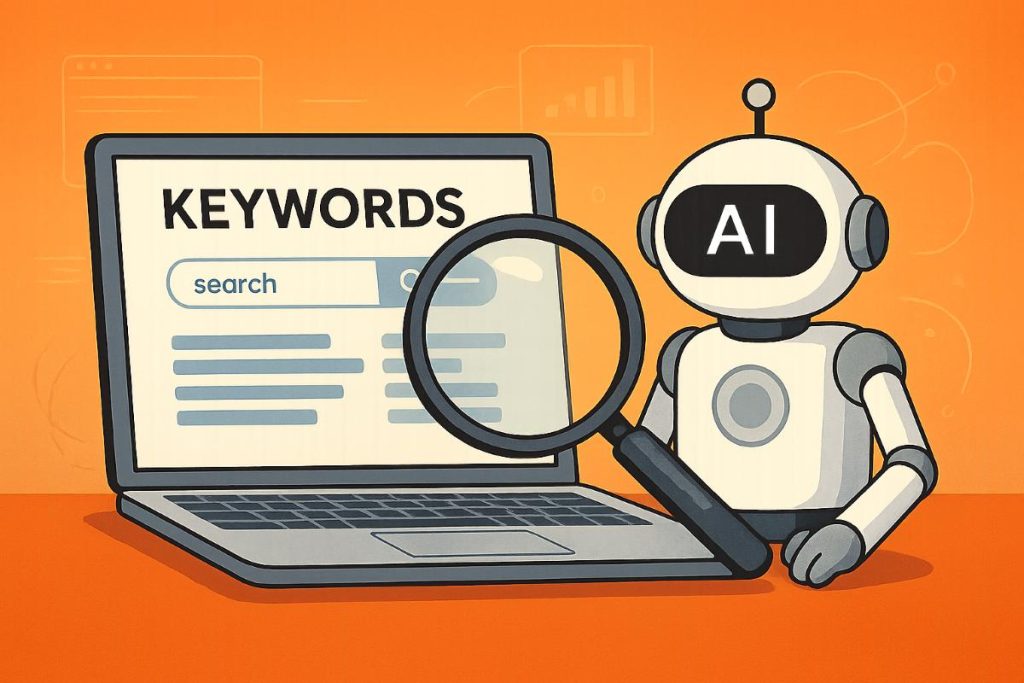
- Discover keyword opportunities
- Study competitors
- Find user questions
- Generate topic ideas
- Identify content gaps
- Recommend headings
- Suggest internal linking opportunities
This saves marketers countless hours every week.
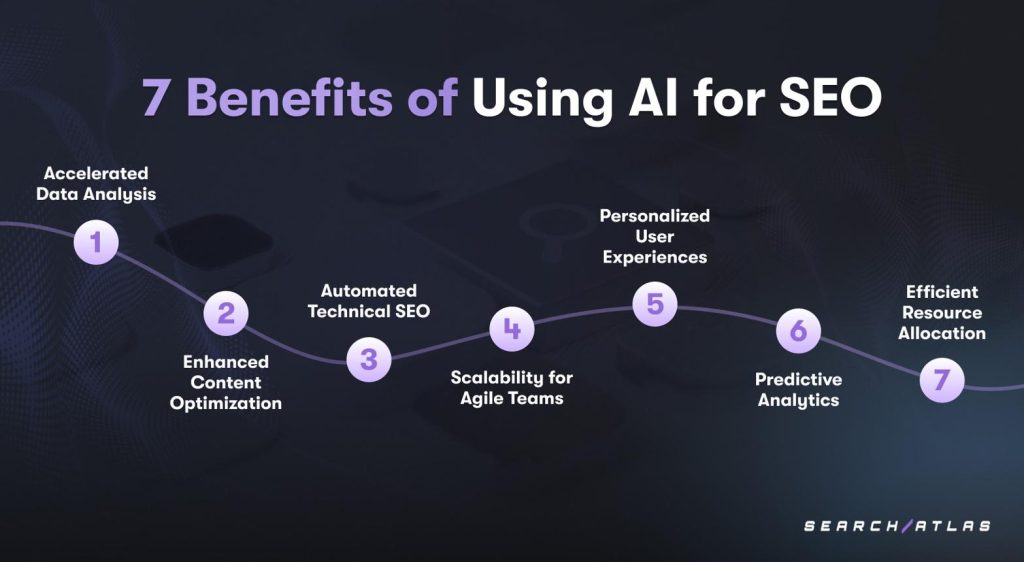
1. Faster Research
Traditional research may take 3–5 hours.
AI reduces this to 20–30 minutes.
That means more time for strategy and creativity.
2. Better Keyword Discovery
AI tools identify:
- High-volume keywords
- Low-competition keywords
- Long-tail keywords
- Question-based keywords
- Semantic keywords
- Related search terms
These help improve your SEO performance.
3. Competitor Analysis
AI can quickly analyze competing websites and identify:
- Top-performing pages
- Keyword gaps
- Content structure
- Backlink opportunities
- Frequently covered topics
This helps you create stronger content than your competitors.
4. Audience Insights
Modern AI tools understand customer intent by analyzing:
- Search queries
- Forums
- Reviews
- Social media discussions
- Community questions
This enables marketers to create content that truly solves audience problems.
5. Content Gap Identification
One of AI’s strongest capabilities is identifying missing content opportunities.
For example:
If your competitors have covered:
- AI SEO
- AI Copywriting
- AI Email Marketing
But nobody has written about:
- AI for Local SEO
AI tools will identify this gap.
Publishing such content gives you a better chance to rank faster.
How AI Improves SEO Content Strategy
Instead of guessing what Google wants, AI analyzes ranking pages and recommends:
- Search intent
- Content depth
- Heading hierarchy
- Frequently used terms
- NLP keywords
- Readability improvements
- FAQ suggestions
- Internal linking opportunities
This makes your content more search-engine friendly.
AI Tools That Help Content Research
| Tool | Best For |
|---|---|
| ChatGPT | Topic Research & Content Planning |
| Google Gemini | Research & Summaries |
| Claude | Long-form Content Analysis |
| Perplexity AI | Web Research |
| Ahrefs | SEO Research |
| SEMrush | Keyword Research |
| Surfer SEO | Content Optimization |
| Frase | Content Briefs |
| AnswerThePublic | User Questions |
| AlsoAsked | Search Intent |
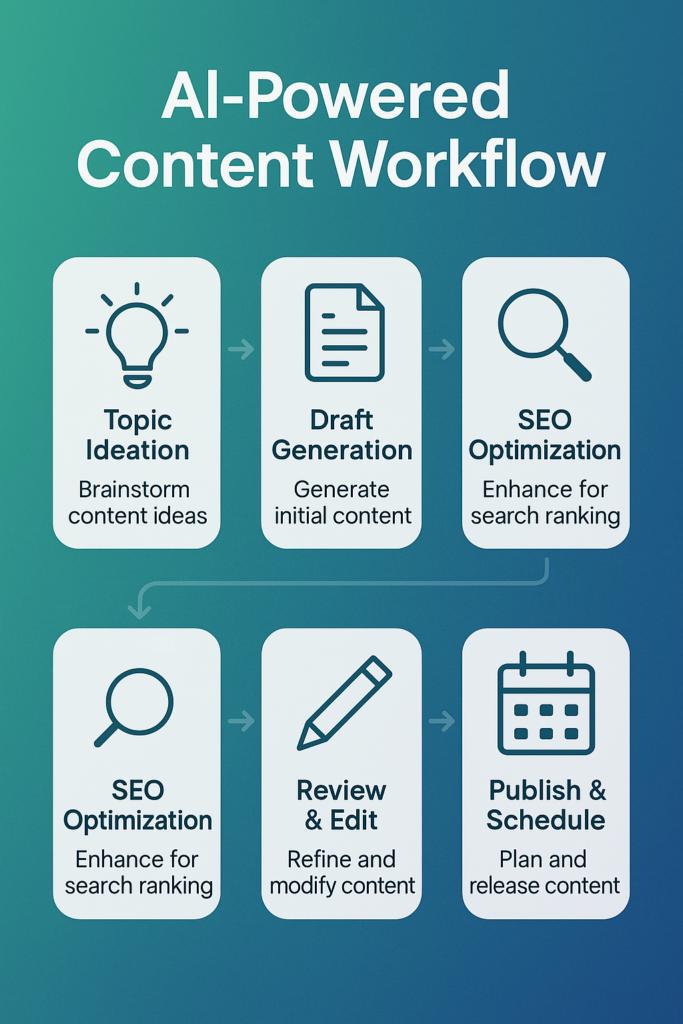
AI-Powered Content Research Workflow
Step 1
Find trending topics.
Example:
Prompt
Find trending AI topics in Digital Marketing for 2026.
Step 2
Research competitors.
Questions:
- What are competitors writing?
- Which articles rank?
- What is missing?
Step 3
Collect keywords.
Example:
Primary Keyword
AI Content Research
Supporting Keywords
- AI SEO
- AI Blogging
- AI Marketing
- AI Keyword Research
Step 4
Understand Search Intent
AI identifies whether users want:
- Information
- Comparison
- Purchase
- Tutorial
- Reviews
Matching search intent significantly improves rankings.
Step 5
Generate Article Outline
AI creates a logical article structure.
Example:
Introduction
↓
Benefits
↓
Tools
↓
Workflow
↓
Best Practices
↓
FAQs
↓
Conclusion
Step 6
Write Human-Friendly Content
AI assists—but your expertise, examples, and brand voice make the content unique and trustworthy.
Common Mistakes to Avoid
❌ Publishing AI-generated content without editing
❌ Ignoring search intent
❌ Keyword stuffing
❌ Copying competitor content
❌ Skipping fact-checking
❌ Forgetting internal links
❌ Not updating old content
Best Practices for AI Content Research
- Use multiple AI tools for broader insights.
- Validate AI-generated facts with reliable sources.
- Add original examples and case studies.
- Optimize headings with target keywords.
- Write naturally for humans first, search engines second.
- Refresh evergreen content regularly.
- Include visuals, FAQs, and actionable tips to improve engagement.
Future of AI in Content Marketing
AI is rapidly evolving beyond research.
Soon it will help marketers with:
- Predictive content planning
- Voice search optimization
- Personalized content recommendations
- Automated content updates
- Real-time SEO monitoring
- AI-powered content performance forecasting
Marketers who adopt AI early will have a significant competitive advantage.
Frequently Asked Questions
Is AI good for SEO content research?
Yes. AI speeds up keyword research, competitor analysis, topic discovery, and search intent analysis, helping marketers create more effective SEO content.
Can AI replace content writers?
No. AI is a powerful assistant for research and drafting, but human creativity, expertise, storytelling, and strategic thinking remain essential.
Which AI tool is best for content research?
There isn’t a single “best” tool. Many marketers combine ChatGPT, Google Gemini, Perplexity AI, Ahrefs, SEMrush, and Surfer SEO for a comprehensive workflow.
Does AI improve Google rankings?
AI itself doesn’t improve rankings. However, using AI to conduct better research and create higher-quality, user-focused content can significantly improve your SEO performance.
Final Thoughts
Artificial Intelligence has fundamentally changed how marketers approach content research. Tasks that once required hours of manual effort—such as discovering keywords, analyzing competitors, identifying content gaps, and understanding search intent—can now be completed in a fraction of the time.
The real advantage isn’t simply creating more content; it’s creating better content that answers user questions, aligns with search intent, and delivers genuine value. By combining AI-powered insights with human expertise, businesses can build stronger SEO strategies, attract more qualified traffic, and stay ahead in an increasingly competitive digital landscape.
At Digital BigBull, we believe AI should empower marketers, not replace them. Use AI as your research assistant, apply your own experience and creativity, and focus on publishing content that helps your audience solve real problems. That’s the foundation of sustainable digital marketing success.
SEO Image Suggestions (Featured & Inline)
- Featured Image (1200 × 628 px):
- Title: The Role of AI in Streamlining Content Research for Digital Marketing Success
- Visual: Futuristic AI assistant analyzing SEO keywords, content dashboards, and analytics with a marketer working on a laptop.
- Inline Image 1:
- AI-powered keyword research dashboard with charts and search trends.
- Inline Image 2:
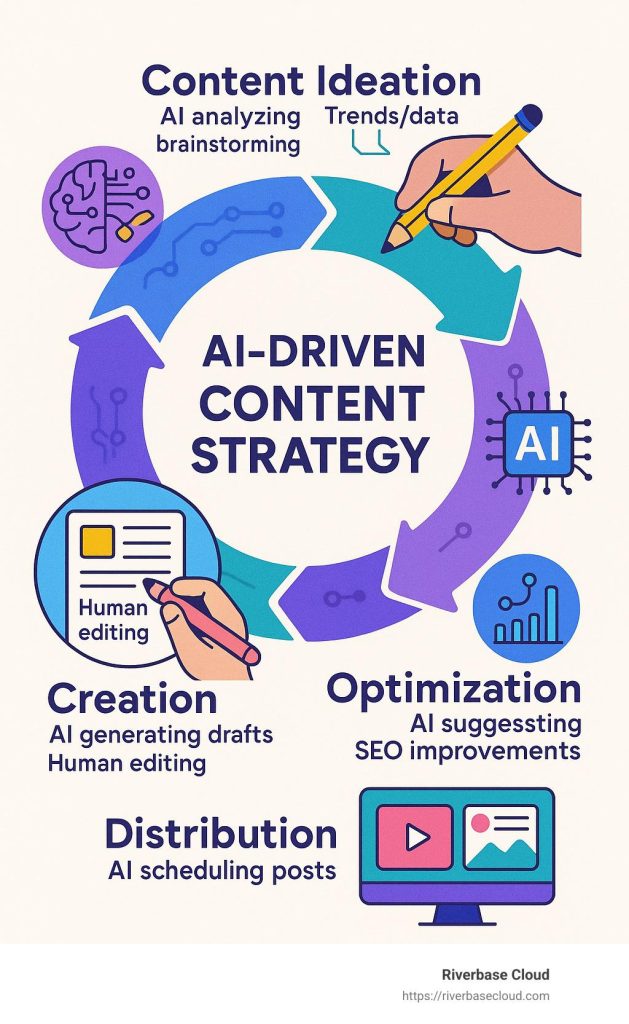
- Content research workflow: Research → Keywords → Competitor Analysis → Content Brief → Writing → SEO Optimization → Publishing.
- Inline Image 3:
- Comparison graphic showing “Traditional Content Research” vs. “AI-Powered Content Research”.